

Is Gabapentin a Safe and Effective Treatment for Cannabis Use Disorder in Older Adults?
Cannabis use vs Gabapentin treatment in elderly: Evidence and clinical considerations
No FDA-approved pharmacotherapy exists for cannabis use disorder (CUD) in any age group; psychosocial interventions (CBT, motivational interviewing) remain first-line
Gabapentin has preliminary RCT evidence for reducing cannabis withdrawal, use, and craving in adults, but relevance to elderly patients is uncertain — no trials specifically in older adults, and results from a later fully-powered replication study suggested no advantage over placebo for cannabis abstinence
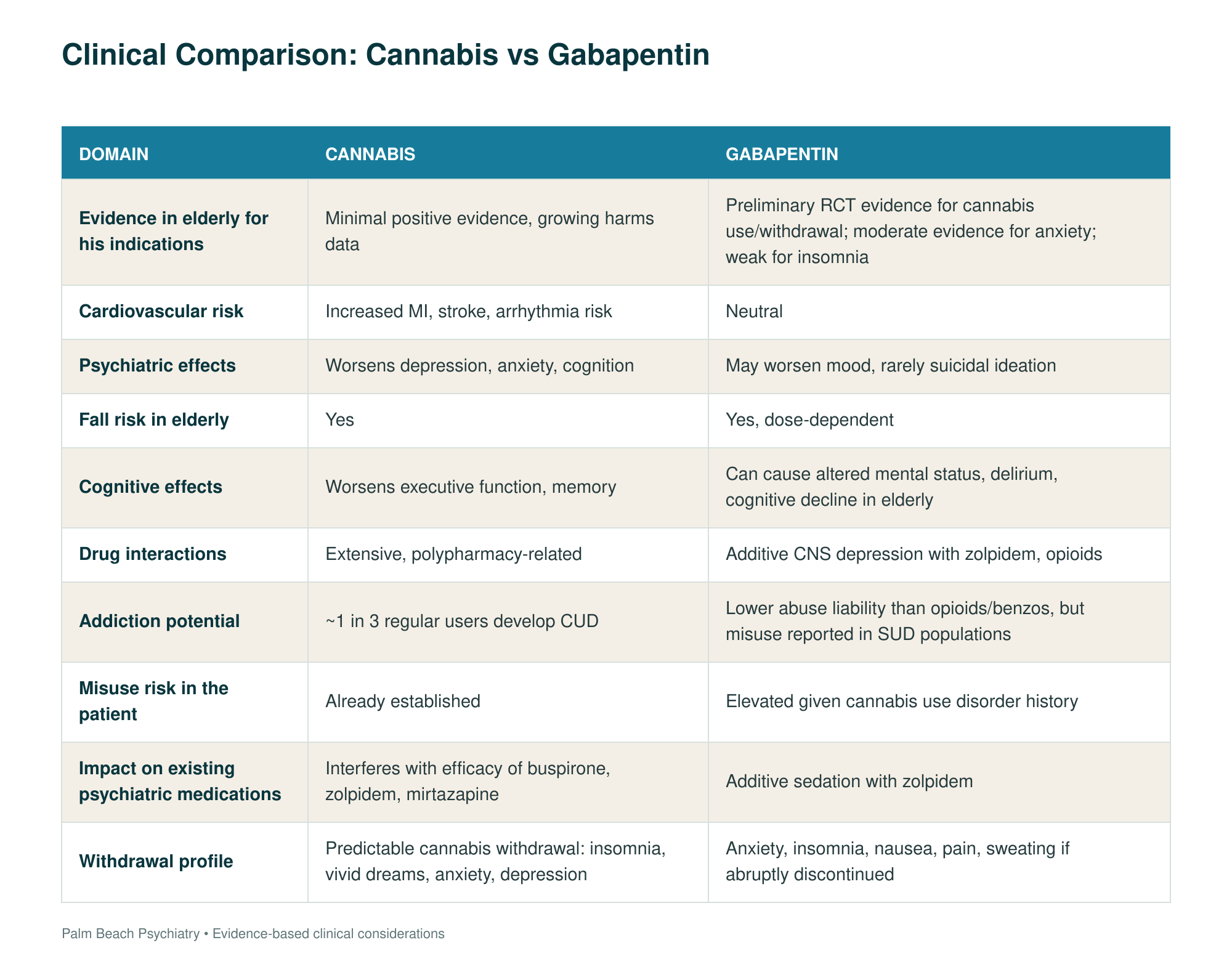
Cannabis use in older adults is associated with greater depression, anxiety, cognitive impairment, substance use, cardiovascular events, falls, and short-term mortality
Daily cannabis users aged ≥50 have 133% increased odds of ≥14 days of poor mental health and 76% increased odds of poor physical health compared to non-users
Cannabis substantially increases cardiovascular risk: pooled evidence shows increased odds of MI (OR ~1.29), stroke, heart failure, and mortality; risk rises with use frequency
Gabapentin in elderly carries meaningful risks: dizziness, somnolence, falls, cognitive decline, altered mental status (particularly at higher doses or with CKD), and additive CNS depression with zolpidem
For the patient specifically: cannabis should be reduced or discontinued; gabapentin at low dose is a reasonable adjunct given his anxiety, insomnia, IBS pain, and cannabis withdrawal support needs — but needs close monitoring for additive CNS effects with zolpidem and cannabis
Evidence for cannabis use in older adults
Perceived benefits (limited and inconsistent)
Older adults most commonly use cannabis for chronic pain, insomnia, and anxiety/mood symptoms
Some smaller trials suggest modest improvements in pain and sleep in specific populations, but benefit-to-risk ratio is unclear
No medical consensus supports cannabis for chronic pain, insomnia, or anxiety in older adults
Documented harms (consistent evidence)
Psychiatric: associated with depression, anxiety, cognitive impairment, amotivation, and increased suicidal ideation in older adults
Cognitive: worsened executive function, memory, and attention — compounding age-related decline
Cardiovascular: increased risk of MI, stroke, arrhythmias, and heart failure; cannabis smoking within 60 minutes raises MI risk up to 4.8-fold
Daily cannabis users ≥50 have 133% higher odds of ≥14 poor mental health days and 76% higher odds of ≥14 poor physical health days
Falls, injuries, accidents — heightened in elderly
Short-term mortality risk increased in adults ≥65 with positive cannabis screening
Polypharmacy interactions — altered pharmacokinetics with aging increases interaction risk
Addiction potential: 20–33% of adults who use cannabis develop CUD; risk higher with regular daily use.
Evidence for gabapentin in cannabis use disorder
Positive preliminary evidence
Mason et al. 2012 proof-of-concept RCT (n=50, gabapentin 1200 mg/day for 12 weeks): significant reductions in cannabis use, withdrawal symptoms, craving, improved sleep (PSQI), mood (BDI-II), and executive function vs placebo
Mechanism: indirectly modulates GABA and normalizes corticotropin-releasing factor signaling disrupted in cannabis withdrawal
Well tolerated in the Mason trial, no evidence of drug substitution
Limiting evidence
Sample sizes are small; high attrition (36% completion in Mason trial)
No data specifically in elderly patients
Unpublished fully-powered replication study suggested gabapentin was no more advantageous than placebo for achieving cannabis abstinence
Cochrane review concludes the evidence base remains weak
Risks in elderly (falls, altered mental status, cognitive decline) must be weighed
Evidence for gabapentin in co-morbid conditions
Anxiety
Moderate evidence for gabapentinoids in anxiety states, particularly pre-operative anxiety (SMD -0.92, 95% CI -1.32 to -0.52) and some panic/social phobia
Case report evidence for GAD, with dose-response pattern
Insomnia
Evidence is inconclusive for primary insomnia
Some studies show improved sleep latency, total sleep time, sleep efficiency in secondary insomnia
IBS
Used off-label, small evidence base
Pain (IBS-related visceral pain)
Well-established efficacy in neuropathic pain; may offer some benefit for visceral pain
Pros and cons
Continuing cannabis
-
May be providing some subjective relief for anxiety and sleep in his perception
-
Compounds his Generalized Anxiety Disorder — contradicts treatment goals
Worsens insomnia and disrupts sleep architecture (undermines medications goals)
Increases suicide risk — stacks on his other risk factors
Cardiovascular risk
Cognitive decline — compounds aging-related changes and undermines advance care planning discussions
Falls especially with other sedating medications
Reinforces existing substance use disorder — worsening his adjustment disorder and addiction trajectory
GI distress may worsen with cannabis use
Federal/state regulatory risk — Schedule I status
Pros and cons
Gabapentin treatment
-
Addresses multiple symptoms simultaneously: cannabis craving/withdrawal, anxiety, sleep, IBS-related discomfort
Rationale for low dose: smaller doses still provide benefit with lower risk of altered mental status
May facilitate zolpidem or benzodiazepine reduction — a long-term goal for insomnia
Well tolerated in Mason trial with minimal side effects
May help IBS-related visceral pain — off-label use
-
Additive CNS depression (example with zolpidem and cannabis)
Fall risk — compounded by his existing zolpidem or benzodiazepine use
Renal function not documented — gabapentin is renally cleared; dose adjustment may be needed
Misuse risk — elevated with substance use disorder history; monitor for self-dose escalation and early refill requests
Altered mental status — dose-dependent in elderly; risk higher with CKD
Evidence for abstinence in CUD is limited — may help symptoms but not reliably produce abstinence
Florida classifies gabapentin as a controlled substance — requires PDMP monitoring
Clinical recommendation
Reduce cannabis first, then consider gabapentin dose adjustment:
Primary goal: discontinue or significantly reduce cannabis use — it is contributing to anxiety, insomnia, cognitive concerns, cardiovascular risk, and undermining treatment.
Gabapentin at current low dose (100 mg QID) is reasonable as an adjunct to cannabis reduction, targeting withdrawal symptoms, anxiety, sleep, and IBS pain
Strict safety monitoring is needed:
Falls, gait, sedation (particularly given concurrent zolpidem or sedating medications)
Cognitive status at every visit
Renal function assessment (baseline BMP with eGFR/CrCl)
PDMP review
Watch for gabapentin misuse signals in the setting of cannabis use disorder
Parallel psychosocial interventions: CBT and motivational interviewing, which are first-line for CUD
Advance care planning as a modifiable harm-reduction strategy given existential concerns
Monitor cardiovascular symptoms closely — any chest pain, palpitations, syncope requires evaluation given cannabis exposure
Cannabis use in older adults is associated with increased depression, anxiety, cognitive impairment, cardiovascular events, falls, and mortality — outweighs perceived benefits
Gabapentin + zolpidem + cannabis = additive CNS depression in elderly; monitor for sedation, falls, and respiratory depression
Gabapentin misuse risk is elevated in patients with cannabis use disorder — watch for dose escalation and early refills